
What the device actually does
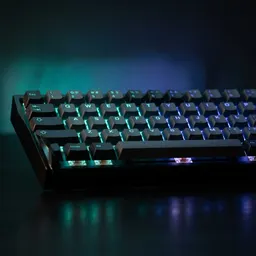
Micro, which OpenAI released last week, is a $230 keypad developed with the specialty keyboard designer Work Louder. Six frosted keys along the top can be assigned to specific tasks inside ChatGPT and Codex; six command keys below them control those programs, and a separate button handles dictation. It connects over Bluetooth or a USB cable. The keys report state by color: white for idle, blue for thinking, green for complete, red for error.[1]
The color scheme looks like the dullest item on the spec list, and I think it is the one original contribution here. What a developer running several agent sessions at once lacks is not another command but a way to see, without changing windows, which session is waiting and which one has failed. Micro moves those four states off the screen and into hardware. Another reading is available: colored keys are ordinary decoration in the keyboard world, and the part that actually builds a habit may be the dictation button, which the review singles out as the most convenient thing the device offers.[1]
Where the setting lives
Key brightness and the command or project bound to each key are set from a Micro tab inside ChatGPT. When a peripheral's configuration lives in one vendor's console, its portability is bounded by that console rather than by the hardware. The review is silent here: it does not say whether a key can be bound to anything outside ChatGPT and Codex, so the gap may sit in the product or in the write-up.[1]
The negative reception quoted in the review is asking the same question. Reddit reviews have been largely negative, and the independent outlet Aftermath found the $230 price hard to justify against cheaper off-the-shelf and do-it-yourself alternatives. The substitution argument is the right argument: if a general-purpose programmable pad does the same job, what Micro adds is the ChatGPT integration — precisely the part you cannot take with you.[1]
What has not been measured
The review states its own limit. Once he had programmed the keys to his liking, the writer enjoyed switching between sessions, but he reports a learning curve and says that since he does not use AI much day to day he may not be the target audience. That is a first-week impression, not a workflow measurement. Here is a testable signal: by the end of September, a written account from an independent developer running several Codex sessions at once, saying whether the red key surfaced a failure earlier than the on-screen notification did. Without such an account, Micro stays a pleasant accessory for heavy ChatGPT users.[1]